Cybernetic Futures
Online Art Exhibitions
Dreamday Express
The Installation

Screen


The Installation Concept
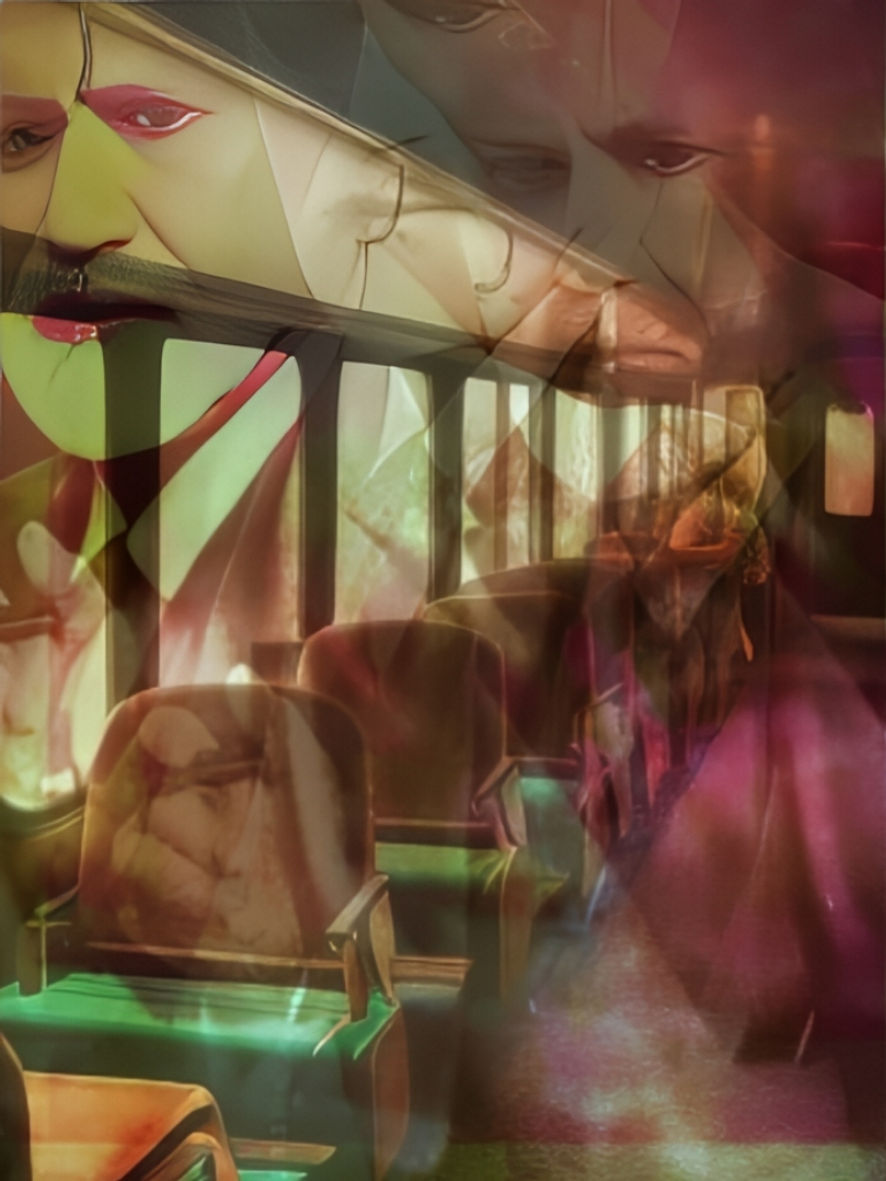
Dreamday Express (2025), part of Freud’s Uncanny Doubles collection (Moore 2024), examines how new technologies—particularly AI—revive primordial fears associated with a non-human animated world. The first scene reimagines the iconic cinematic moment when the train arrived at La Ciotat Station in 1896, filmed by the Lumière brothers. Drawing on screenshots from the original footage—subsequently altered and reanimated—a woman steps forward, becoming the protagonist of a dream journey that merges historical reality with the vistas of her unconscious.
Presented as a two-channel installation, the artwork is divided into two distinct yet interconnected train journeys. On one screen, the travelling woman passes through landscapes that dissolve into fluid architectures of light and colour, echoing nineteenth-century Impressionist paintings. Waltzing couples, ballerinas, and women appearing as her doubles traverse fantastical train stations that transform into dance halls and immersive environments. On the other screen, scenes of trains crashing, exploding, and disintegrating coincide with the protagonist’s doubles wandering like apparitions through traumatic, nightmarish landscapes of railways and wreckage For the viewer, one screen reflects a pole of a choreographed dreamscape of light, colour and movement, while the other projects a nightmarish collapse marked by the splitting of selves and machines. These two poles exert their presence simultaneously, and it is between them that the dialogic encounter unfolds, with the image of the train operating as a unifying metaphor. Trains and railways have long functioned as metaphors for cinema itself, for moving image technologies, and for the oscillation between stillness and
movement (Blümlinger 2025; Mulvey 2006). Both trains and dance—most notably in The Red Shoes—are associated with accelerated motion and fatal accidents (Mulvey 2006). The landscapes for Dreamday Express were generated by an AI model trained on the colours, structures, and atmospheres of vintage trains and stations. Through choreographic aesthetics, these AI-crafted and digitally edited textures form the inner landscape of a passage into the dreamlife of a woman suspended between technologically driven eras.



FREUD'S UNCANNY DOUBLES


Freud's Manifested Doubles - Edited generated images based on Max Halberstadt's photographs of Freud.
Freud's Uncanny Doubles Collection and Immersive Installation
The concept behind Freud's Uncanny Doubles Collection and immersive installation is explored in Lila Moore’s article, Technoetic Magick: Explorations of the Uncanny Double as a Noetic and Magickal System through the Complementary Lenses of AI Image-Generation and AR. This paper was first presented at EVA London in July 2024.
The article is available via [Science Open – link].
The collection is currently being further developed using emerging technologies, expanding its immersive and technoetic dimensions.
Presentation and Paper by Lila Moore
EVA London, July 2024
THE INSTALLATION

Variation I: The Luminous Waltz
Artist: Lila Moore
Duration: 10 minutes
Format: MP4, H.264
Resolution: HD/4K
Edition: 5 + 1 AP
Price: Upon request
Display: Looping video artwork designed for digital frame for home display or gallery installation.
Includes: Certificate of Authenticity
Artist Statement by Lila Moore
Dreamday Express reimagines the iconic moment in cinema history when the Lumière brothers’ train arrived at La Ciotat Station in 1896. From within that early cinematic scene, one woman steps forward—becoming the protagonist of a dream-journey that merges historical reality with the shimmering depths of the unconscious.
Inspired by Sigmund Freud’s 1919 essay “The Uncanny,” the film follows her as the familiar rhythms of the railway shift into a realm where desire, memory, trauma, and fantasy intertwine. Train carriages, platforms, waltzing couples, and passing landscapes dissolve into fluid architectures of light that echo nineteenth-century Impressionist paintings.
The immersive visual patterns were generated by an AI model trained on the colours, structures, and atmospheres of vintage trains and stations. Through choreographic aesthetics, these AI-crafted textures form the inner landscape of the Dreamday Express—a passage into the dreamlife of a woman suspended between eras.